

Architectural practice requires a balance of design intent, technical accuracy, and coordination across multiple disciplines. While architects lead the creative and spatial aspects of a project, Mechanical, Electrical, and Plumbing (MEP) systems play a critical role in determining how a building performs, complies with codes, and functions in the real world.
As project complexity increases, architectural firms are expected to deliver fully coordinated construction documents that integrate MEP systems seamlessly into the design. However, managing MEP engineering in-house or through disconnected consultants often introduces coordination gaps, delays, and rework.
This is where dedicated MEP engineering support becomes essential.
IMEP Engineering partners with architectural firms across the United States as a dedicated MEP engineering support team. We integrate directly into your design process from schematic design through construction administration. Our goal is to help architectural teams deliver well-coordinated, code-compliant, and buildable designs while maintaining design intent.
The MEP Challenge in Architectural Practice
MEP systems are not secondary components. They directly influence space planning, structural coordination, energy performance, and overall building functionality. For architectural firms, this creates several practical challenges.
MEP Systems Influence Design Decisions
Mechanical equipment, duct routing, plumbing risers, and electrical systems all occupy physical space within a building. These systems impact:
- Ceiling heights and plenum spaces
- Shaft locations and sizes
- Equipment room layouts
- Structural coordination and clearances
When MEP coordination occurs late in the design process, it often results in conflicts that require redesign. This leads to inefficiencies and can compromise design intent.
Coordination Gaps with Independent Consultants
Many architectural firms rely on independent MEP consultants engaged on a project-by-project basis. While this model is common, it introduces coordination challenges:
- Limited integration with the design process
- Communication gaps between teams
- Delayed feedback on design decisions
- Increased risk of inconsistencies in deliverables
Without continuous involvement, MEP consultants may only receive finalized information instead of participating in the evolving design.
Increasing Code and Compliance Complexity
MEP systems must comply with multiple regulatory US-based code frameworks, including:
- International Building Code (IBC)
- International Energy Conservation Code (IECC)
- ASHRAE standards
- National Electrical Code (NEC)
- Local jurisdiction requirements
Ensuring compliance requires ongoing attention to updates, interpretations, and jurisdiction-specific amendments. This requires dedicated expertise.
BIM and Coordination Expectations
With BIM now standard across the industry, expectations for coordination have increased significantly. Owners and contractors expect:
- Fully developed 3D MEP models
- Clash detection and resolution
- Coordinated documentation across disciplines
Achieving this level of coordination requires expertise in tools like Revit, Navisworks, and cloud-based collaboration platforms, along with strong coordination workflows.
Real Challenges Architects Face in MEP Coordination
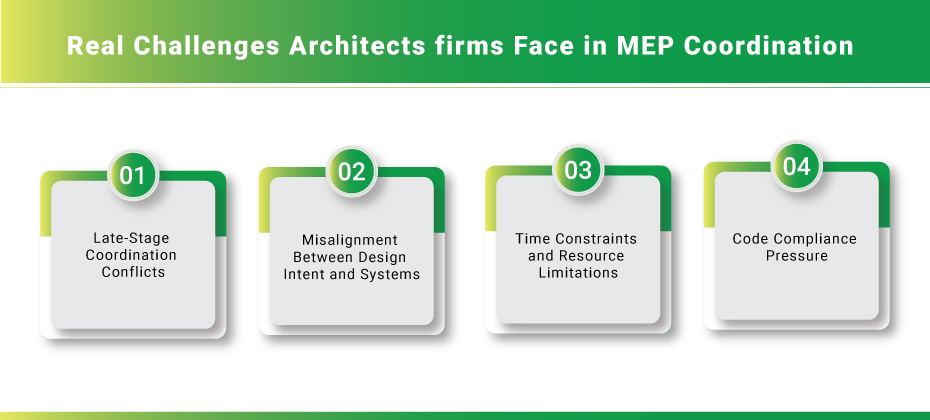
In practice, architectural firms often encounter challenges that directly affect project outcomes.
Late-Stage Coordination Conflicts
MEP systems are sometimes introduced after key architectural decisions are made. This results in conflicts with ceiling heights, structural elements, or spatial layouts.
Misalignment Between Design Intent and Systems
Architectural design often prioritizes aesthetics and spatial experience. MEP systems require routing, clearances, and equipment placement that must be carefully integrated.
Time Constraints and Resource Limitations
Architectural teams are frequently managing multiple projects simultaneously. This leaves limited time to focus on detailed MEP coordination.
Code Compliance Pressure
Ensuring that designs meet evolving code requirements requires consistent attention and technical knowledge across all project phases.
How Dedicated MEP Engineering Support Helps
Partnering with a dedicated MEP engineering support company allows architectural firms to address these challenges effectively.
- MEP systems are coordinated early in the design process
- Conflicts are identified and resolved before construction
- Code compliance is integrated into the design from the start
- BIM models are developed and coordinated with architectural intent
- Construction documents are more complete and accurate
The result is a smoother workflow, fewer revisions, and improved project outcomes.
What IMEP Engineering Provides
IMEP Engineering delivers comprehensive MEP engineering support tailored specifically for architectural firms.
Mechanical Engineering Design Support
- HVAC load calculations and system selection
- Ductwork and piping design
- Equipment room and mechanical space planning
- Energy code compliance documentation
- Coordinated construction drawings and specifications
Plumbing Engineering Design Support
- Domestic water, sanitary, and storm system design
- Fixture calculations and pipe sizing
- Riser diagrams and system layouts
- Code compliance and fixture coordination
- Detailed construction documentation
Electrical Engineering Design Support
- Power distribution and load calculations
- Lighting design and layout coordination
- Panel schedules and one-line diagrams
- Fire alarm and low-voltage coordination
- Complete electrical construction drawings
Construction Administration Support
- RFI responses related to MEP systems
- Submittal reviews
- ASI and design modifications
- Site observation support
- Punch list and closeout assistance
How IMEP Engineering Integrates With Your Design Process
IMEP Engineering is structured to function as an extension of your architectural team, not as an external consultant operating in isolation.
Schematic Design
Early engagement allows us to provide input on:
- Mechanical space requirements
- Structural and architectural coordination
- Feasibility of ceiling heights and layouts
- MEP system strategy
This helps establish a strong foundation before design decisions become difficult to change.
Design Development
During this phase, systems are defined and coordinated:
- Equipment selection and sizing
- System routing and spatial coordination
- Identification and resolution of conflicts
- Ongoing collaboration with the design team
Construction Documents
We focus on delivering:
- Fully coordinated drawing sets
- Complete and accurate documentation
- MEP systems aligned with architectural intent
- Internal quality control before submission
Why Architectural Firms Choose IMEP Engineering Over Independent Consultants
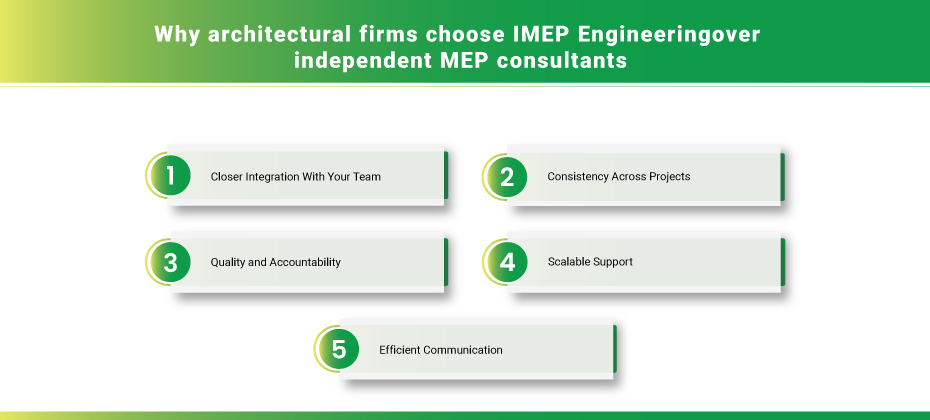
Closer Integration With Your Team
We work within your design process and participate in reviews and coordination discussions throughout the project lifecycle.
Consistency Across Projects
Our team learns your standards, workflows, and preferences. This ensures consistent quality across all projects.
Quality and Accountability
Every deliverable undergoes internal quality control before it reaches your team. This ensures accuracy and coordination.
Scalable Support
Whether you have a single project or multiple active engagements, we scale our resources to match your workload.
Efficient Communication
We operate in US time zones, which enables real-time communication and faster decision-making.
IMEP Engineering Support vs. Independent MEP Consultants
| Factor | IMEP Engineering | Independent MEP Consultant |
| Integration With Design Process | Embedded from schematic design through CA | Typically engaged after SD, works at arm’s length |
| Early Design Input | MEP input during schematic design to inform layout decisions | Usually begins at design development or later |
| Communication Cadence | Ongoing — available for questions, reviews, and coordination throughout | Milestone-based — submits at scheduled intervals |
| Coordination Quality | Internal QC on every deliverable before submission | Varies — depends on consultant’s internal process |
| Design Conflict Resolution | Flags and resolves MEP-architectural conflicts proactively | Conflicts often surface at submission or in the field |
| Consistency Across Projects | Same team, same standards, same process every project | Different consultant or team each engagement |
| Schedule Flexibility | Adjusts resources to meet compressed timelines | Schedule changes require renegotiation |
| BIM Capability | Full Revit modeling and Navisworks coordination | Varies significantly by consultant |
| US Code Knowledge | IBC, NEC, ASHRAE, NFPA, and jurisdiction-specific requirements | Varies by consultant and region of practice |
| Scalability | Scales with your project load across multiple projects | Each engagement is a separate contract and negotiation |
Where IMEP Engineering Makes the Biggest Difference for Architects
- Architectural firms without in-house MEP teams
- Firms seeking tighter coordination and control
- Projects with complex MEP requirements
- Teams managing multiple concurrent projects
- Firms expanding into new project types
Conclusion
As architectural projects become more complex, MEP coordination has become a critical factor in delivering successful outcomes. Partnering with a dedicated MEP engineering support company allows architectural firms to integrate technical expertise directly into their design process.
IMEP Engineering is built to function as a collaborative engineering partner. We help architectural firms improve coordination, ensure compliance, and deliver high-quality, buildable designs.
For architectural firms seeking reliable, consistent, and integrated MEP support, the right partnership can make a measurable difference in both process and project outcomes.