

Every architect and general contractor is familiar with the sinking feeling of receiving an MEP package with multiple comments during MEP Plan Check.
Marked-up drawings usually signal one thing: rework. And rework means delays, budget pressure, and coordination issues that no one planned for at the beginning of the project.
What most teams overlook is that issues raised during MEP Plan Check are rarely random. They are not just documentation errors; they are often the outcome of predictable, repeatable design-stage triggers that originate much earlier in the project lifecycle.
Research shows that rework can account for 5% to 8% of total project cost, and in many large-scale projects, it can go even higher. Now consider this: MEP systems typically represent 30% to 40% of total construction cost in commercial buildings. This combination makes unresolved MEP coordination one of the most expensive risk factors in construction.
Understanding what truly causes MEP Plan Check comments and eliminating those issues early is one of the highest-impact decisions architects and contractors can make.
The Real Cause Most Teams Overlook
The majority of issues flagged during MEP Plan Check do not originate during review itself.
Instead, they are created silently during the design phase, long before submission.
A common issue is sequencing. Architectural layouts are often finalized before MEP input is fully integrated into the design process. This creates a cascading set of conflicts.
For example:
- Ceiling heights are locked before HVAC duct sizing is complete
- Shaft locations are fixed without fully coordinated system routing
- Electrical room layouts are defined before load calculations are finalized
Once MEP systems are forced into pre-defined architectural constraints, coordination issues become unavoidable.
These systems are also deeply interdependent. A minor adjustment in one discipline can affect multiple others:
- Structural beams can obstruct duct routing
- Plumbing stacks can interfere with fire riser alignment
- Electrical conduit congestion can reduce usable ceiling space
When these issues are not identified early, they accumulate into repeated comments during MEP Plan Check reviews.
Industry studies consistently show that MEP-related rework is one of the largest contributors to construction cost overruns, often forming a significant portion of the 10–15% total rework burden seen across projects.
The Most Common Hidden Triggers Behind MEP Plan Check Issues
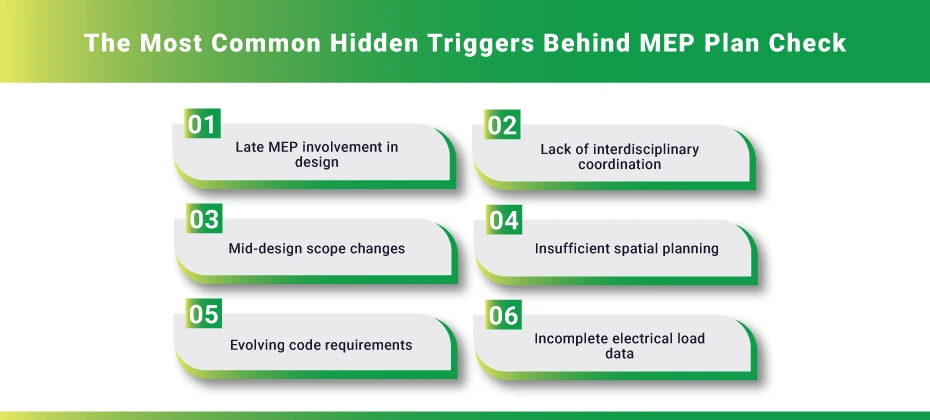
Not all MEP Plan Check comments are random. In fact, most stem from recurring coordination breakdowns across projects.
Below are the most consistent triggers seen in real-world construction workflows:
1. Late MEP involvement in design
When MEP input arrives after architectural decisions are locked, ceiling heights, shaft sizes, and plant room layouts become restrictive and conflict-prone.
2. Lack of interdisciplinary coordination
Poor alignment between architectural, structural, and MEP models leads to clashes between:
- Beams and ductwork
- Slabs and piping routes
- Structural elements and electrical risers
3. Mid-design scope changes
Untracked design changes force MEP systems to adapt to updated layouts, often creating inconsistencies flagged during MEP Plan Check.
4. Insufficient spatial planning
Undersized ceiling plenums and mechanical rooms result in:
- On-site rerouting
- Plan Check comments on constructability
- Compromised system performance
5. Evolving code requirements
Changing regulations during long project cycles require continuous updates to MEP design. Without proper tracking, compliance gaps appear during Plan Check submission.
6. Incomplete electrical load data
Missing or inaccurate load summaries lead to incorrect panel schedules and repeated comments during review cycles.
Each of these triggers is avoidable. The challenge is not awareness after submission but recognition during early design stages when corrections are still inexpensive.
Why Timing Is Everything in Avoiding MEP Plan Check Issue
In MEP coordination, timing determines cost impact and approval efficiency.
A coordination issue identified during schematic design (SD) can typically be resolved quickly. The same issue discovered during construction documentation (CD) may require redesign. If identified during MEP Plan Check, it can lead to repeated review cycles and approval delays. If discovered on-site, it can halt trades entirely.
The later a conflict is discovered, the more expensive and disruptive it becomes.
This is why early-stage MEP involvement is critical. When MEP engineers participate during SD and early design development:
- Shaft locations are optimized before locking layouts
- Ceiling heights are validated against actual system requirements
- Equipment room sizes are aligned with real spatial needs
Contractors using coordinated BIM workflows prior to construction report significantly fewer RFIs during execution. In many documented cases, early clash detection delivers a return on investment of up to 10:1 by reducing field rework and Plan Check iterations.
How Early Planning Systematically Eliminates MEP Plan Check Issues
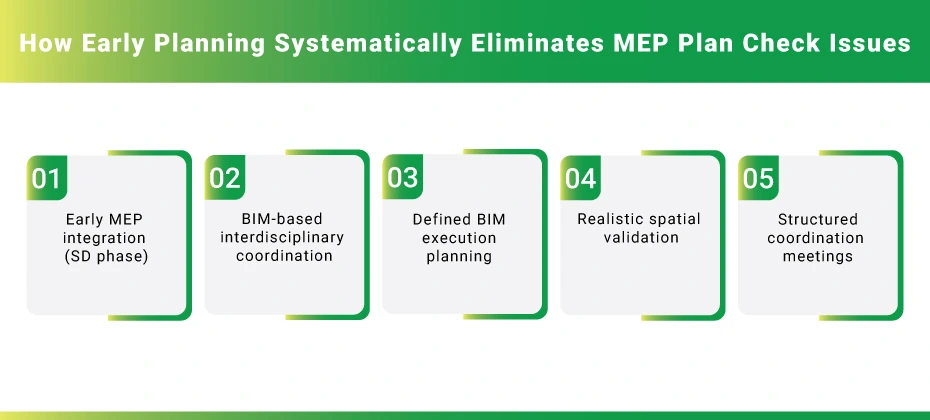
Early planning is not just a concept it is a structured coordination workflow that directly reduces review comments and approval delays.
The most effective practices include:
1. Early MEP integration (SD phase)
Engaging MEP engineers early allows system requirements to influence architectural decisions before constraints are locked.
2. BIM-based interdisciplinary coordination
Using tools such as Revit and Navisworks ensures conflicts are identified digitally before submission, reducing Plan Check comments.
3. Defined BIM execution planning
A clear BIM execution plan establishes:
- Modeling standards
- Coordination workflows
- Clash resolution procedures
4. Realistic spatial validation
Ceiling spaces and mechanical zones are verified against actual system sizes, including ductwork, piping, conduit bundles, and insulation layers.
5. Structured coordination meetings
Regular design-stage coordination meetings ensure all disciplines are aligned at every milestone before submission.
These steps shift problem-solving from Plan Check review cycles to design environments where solutions are faster, cleaner, and significantly more cost-effective.
How IMEP Engineering Prevents Issues During MEP Plan Check Through Early Coordination
At IMEP Engineering, we specialize in eliminating these hidden triggers before they impact approval cycles or construction.
Our team of U.S.-licensed Professional Engineers provides coordinated, code-compliant MEP design support for architects, contractors, and developers. We focus on early-stage integration, clash-free documentation, and constructible design solutions that reduce review comments and improve project certainty.
By addressing coordination issues at the SD and DD stages, we help ensure your projects move forward with fewer MEP Plan Check iterations, fewer delays, and significantly reduced field conflicts.
If your goal is to eliminate MEP Plan Check issues before they appear in submission cycles, early coordination is the most effective place to start.
Conclusion
MEP Plan Check issues are not inevitable. They are the result of predictable coordination gaps that form early and surface late.
Architects and contractors who understand these hidden triggers can actively eliminate them by shifting focus upstream into early design coordination and structured planning.
Shifting coordination upstream into early design phases is the most effective way to reduce cost, improve constructability, and eliminate repeated MEP Plan Check cycles.