

Retail construction projects move fast. Whether it’s a tenant improvement, franchise rollout, restaurant build-out, or mixed-use retail space, project schedules are often tied directly to lease obligations, opening dates, and revenue targets.
For architecture firms in the USA managing these projects, permit delays can quickly disrupt timelines, impact coordination, and create unnecessary pressure across the project team.
In many cases, permit challenges are not caused by architecture alone. They stem from incomplete or poorly coordinated MEP documentation that creates review comments during the permitting process.
As building codes continue to evolve across U.S. jurisdictions, early MEP coordination has become increasingly important for maintaining project momentum and reducing resubmission cycles.
Here are seven common MEP coordination issues that frequently delay retail permit approvals and why they matter during project delivery.
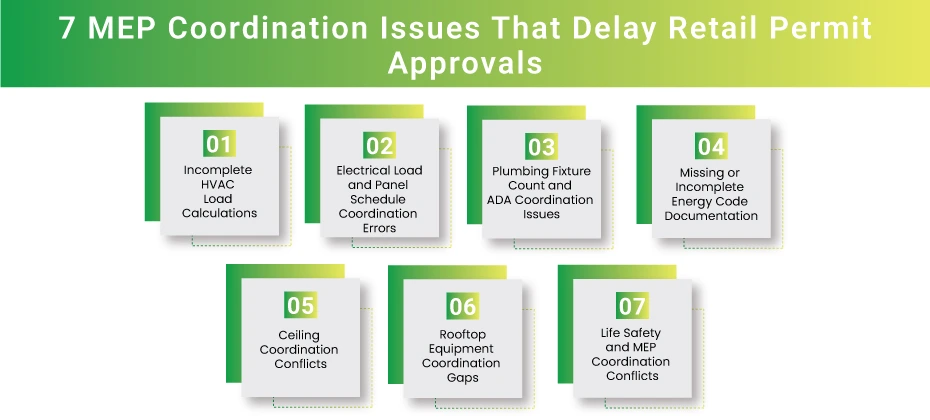
1. Incomplete HVAC Load Calculations
Mechanical review comments are one of the most common reasons retail projects get delayed during permitting.
This often happens when HVAC load calculations do not align with:
- Incorrect consideration for building orientations.
- Infiltration not considered.
- Incorrect equipment gain calcs.
- updated occupancy requirements
- tenant layout revisions
- ventilation standards
- equipment schedules
- outside air calculations
Retail spaces frequently change during design development, especially in tenant improvement projects where layouts, occupancy, or equipment requirements evolve late in the process.
When mechanical documentation is not fully coordinated, plan reviewers may request additional calculations, revised schedules, or clarification before approval can move forward.
Even small inconsistencies between plans and calculations can create avoidable permit review cycles.
2. Electrical Load and Panel Schedule Coordination Errors
Retail spaces typically include a combination of:
- lighting systems
- signage
- point-of-sale equipment
- kitchen appliances
- refrigeration systems
- specialty tenant equipment
As these systems change throughout design, electrical coordination issues can quickly appear if documentation is not updated consistently.
Common permit review issues include:
- incomplete panel schedules
- inconsistent connected loads
- missing single-line diagrams
- mismatched equipment loads
- insufficient circuit coordination
Electrical review comments often lead to revisions that affect multiple sheets and disciplines, extending the overall permit timeline.
3. Plumbing Fixture Count and ADA Coordination Issues
Plumbing coordination becomes especially important in retail and restaurant projects where occupancy classifications and restroom requirements directly affect code compliance.
Permit delays commonly occur when:
- fixture counts do not match occupancy loads
- restroom layouts change late in design
- ADA clearances are overlooked
- plumbing schedules are not coordinated
- tenant revisions are not reflected across drawings
These issues may seem minor initially, but they frequently generate review comments that require redesign and resubmission.
For fast-track retail projects, even small plumbing coordination gaps can impact permitting schedules and construction sequencing.
4. Missing or Incomplete Energy Code Documentation
Energy compliance requirements continue to become more detailed across many U.S. jurisdictions.
Retail permit submissions are often delayed because of:
- incomplete IECC documentation
- missing lighting control information
- Title 24 coordination gaps
- inconsistent envelope coordination
- incomplete commissioning notes
In many cases, the project design itself may be compliant, but incomplete supporting documentation can still trigger permit comments and review delays.
As energy codes become increasingly strict, coordinated documentation between architectural and MEP disciplines is essential for smoother approvals.
5. Ceiling Coordination Conflicts
Retail interiors frequently contain dense ceiling layouts with multiple systems competing for limited space.
These systems often include:
- ductwork
- lighting
- sprinklers
- speakers
- security devices
- signage elements
Without early coordination, ceiling conflicts may not become visible until permit review or construction.
This can create:
- redesign requests
- RFIs during construction
- coordination revisions
- delays in field installation
Retail projects with exposed ceilings or compact tenant spaces are especially vulnerable to these coordination challenges.
Proper multi-discipline coordination during design helps reduce these conflicts before they affect permitting or construction schedules.
6. Rooftop Equipment Coordination Gaps
Rooftop equipment coordination is another common source of permit review comments in retail projects.
Mechanical rooftop systems require coordination across several disciplines, including:
- architectural
- structural
- electrical
- accessibility
- local zoning requirements
Permit issues often occur when drawings lack coordination related to:
- structural supports
- roof penetrations
- equipment clearances
- electrical disconnect locations
- rooftop screening requirements
Many jurisdictions enforce strict requirements for rooftop visibility, maintenance access, and equipment placement.
Without early coordination, these issues can create additional review comments and delay permit approvals.
7. Life Safety and MEP Coordination Conflicts
Life safety coordination issues can create some of the most time-consuming permit revisions because they often affect multiple disciplines simultaneously.
Common examples include:
- exit path conflicts
- fire damper coordination gaps
- emergency power inconsistencies
- smoke control issues
- fire-rated penetration conflicts
When MEP systems are not fully coordinated with life safety requirements, reviewers may require revisions across mechanical, electrical, plumbing, and architectural sheets.
These changes can significantly extend permit review timelines and impact overall project delivery.
For retail projects operating on compressed schedules, resolving these conflicts early is critical.
Why Early MEP Coordination Matters in Retail Projects
Retail and tenant improvement projects operate under tight timelines where every review cycle matters.
Additional permit comments can affect:
- contractor scheduling
- procurement timelines
- store opening dates
- tenant turnover schedules
- construction sequencing
- overall project costs
For architecture firms managing multiple retail projects, strong MEP coordination is not just about engineering production. It directly affects project efficiency, communication, and delivery reliability.
Early collaboration between architecture and MEP teams helps improve:
- submission quality
- permit readiness
- cross-discipline coordination
- constructability
- overall project workflow
Reducing coordination gaps before submission often leads to smoother permitting and fewer disruptions later in the project lifecycle.
How IMEP Engineering Supports Architecture Firms on Retail Projects
Retail and tenant improvement projects require more than standard engineering production. Tight schedules, evolving tenant requirements, and fast-track permit timelines demand coordinated MEP support that aligns closely with the architectural workflow.
At IMEP Engineering, we partner with architecture firms across the United States to help streamline retail project delivery through coordinated HVAC, plumbing, and electrical design services.
Our MEP team supports architects by helping reduce common permitting and coordination challenges through:
- Permit-ready MEP documentation
- Coordinated HVAC, plumbing, and electrical design
- Fast-turnaround support for retail and TI projects
- Multi-discipline coordination assistance
- Code-compliant design workflows
- BIM/CAD-based coordination support
- Scalable production support for growing project pipelines
We understand that architects need more than technical drawings. They need responsive engineering partners who can support project momentum, reduce friction during permitting, and help maintain delivery timelines across multiple stakeholders.
Whether supporting a single retail tenant improvement or a multi-location rollout program, IMEP Engineering works as an extension of the architectural team to help improve coordination, efficiency, and overall project execution.
Conclusion
Most retail permit delays are not caused by a single major issue. More often, they result from small coordination gaps that compound during plan review.
As retail construction timelines continue to accelerate, early MEP coordination becomes increasingly important for reducing permit comments, improving project flow, and maintaining delivery schedules.
For architecture firms managing retail and tenant improvement projects, coordinated engineering support can play a significant role in reducing friction throughout the permitting and construction process.
Strong collaboration between architecture and MEP teams ultimately leads to smoother approvals, better coordination, and more efficient project delivery from design through construction.