

Architectural projects often appear “ready for permit submission,” yet still face unexpected delays during plan review.
In many cases, the drawings are architecturally complete but Mechanical, Electrical, and Plumbing (MEP) code compliance issues trigger multiple correction cycles from building departments.
These issues are one of the most common hidden reasons for permit delays across residential, retail, restaurant, and office tenant improvement projects.
For architecture firms, this creates real challenges:
- Re-submittals and redesign effort
- Project schedule delays
- Increased coordination pressure
- Client frustration due to timeline shifts
While architects focus on design intent and spatial planning, MEP systems must also fully comply with evolving code requirements and be properly coordinated before submission.
This article highlights the most common MEP-related code issues that delay permits and how architects can reduce them through better early-stage coordination.
Why MEP Code Issues Delay Permits
Building departments review MEP systems in detail because they directly impact:
- Occupant safety
- Indoor air quality and ventilation
- Energy efficiency compliance
- Electrical system safety
- Plumbing sanitation and accessibility
Even small inconsistencies between architectural drawings and MEP systems can result in multiple rounds of review comments.
The most important takeaway for architecture teams is:
Most permit delays are not caused by design intent but by incomplete or misaligned MEP coordination during documentation.
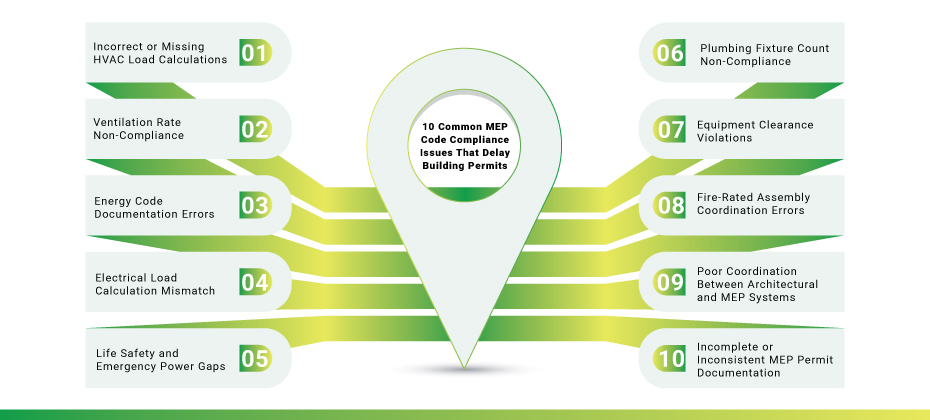
10 Common MEP Code Compliance Issues That Delay Building Permits
1. Incorrect or Missing HVAC Load Calculations
One of the most frequent mechanical review issues is incomplete or inaccurate HVAC load calculations.
Common problems include:
- Missing heating and cooling load documentation
- Incorrect occupancy assumptions
- Undersized or oversized HVAC system selection
- Lack of alignment with architectural space use
When load calculations do not match the architectural program, reviewers request revisions or clarification, delaying approval.
2. Ventilation Rate Non-Compliance
Ventilation is strictly regulated and directly tied to occupancy and space function.
Common issues include:
- Insufficient outdoor air calculations
- Incorrect ventilation rates based on space type
- Misalignment between architectural layout and mechanical design
This often results in mechanical plan corrections and recalculation requirements.
3. Energy Code Documentation Errors
Energy compliance is one of the most common causes of permit resubmittals.
Typical issues include:
- Missing or incomplete compliance forms
- Incorrect energy modeling assumptions
- HVAC systems not aligned with envelope design
- Inconsistent documentation between disciplines
Because energy codes are tightly enforced in most jurisdictions, even small gaps can delay approvals.
4. Electrical Load Calculation Mismatch
Electrical systems must be carefully aligned with actual building demand.
Common issues include:
- Panel schedules not matching calculated loads
- Incomplete load breakdowns
- Incorrect service sizing
- Missing allowances for future load expansion
When electrical loads are inconsistent, reviewers often require revised riser diagrams and panel schedules.
5. Life Safety and Emergency Power Gaps
Life safety systems are among the most heavily reviewed components in permit submissions.
Common issues include:
- Missing emergency lighting coverage
- Incomplete exit lighting layouts
- Unclear emergency power assumptions
- Inadequate backup system coordination
These issues are treated as high priority and can significantly delay approvals.
6. Plumbing Fixture Count Non-Compliance
Plumbing compliance issues often arise from incorrect occupancy or fixture calculations.
Common problems include:
- Fixture counts not aligned with occupancy loads
- Misinterpretation of code requirements
- Accessibility compliance gaps
Even minor errors can result in full plumbing plan revisions.
7. Equipment Clearance Violations
MEP equipment must meet strict accessibility and clearance requirements.
Common issues include:
- HVAC equipment placed without maintenance access
- Electrical panels without required working clearance
- Rooftop equipment without proper access pathways
These issues typically require redesign before approval.
8. Fire-Rated Assembly Coordination Errors
Fire safety coordination between architecture and MEP systems is critical.
Common issues include:
- Ducts or pipes passing through rated walls without proper detailing
- Missing firestopping specifications
- Incomplete rated assembly coordination
These issues often result in both architectural and MEP revision cycles.
9. Poor Coordination Between Architectural and MEP Systems
One of the most common underlying causes of permit delays is coordination gaps.
Typical conflicts include:
- Ductwork interfering with structural beams
- Plumbing lines conflicting with ceiling design
- Mechanical equipment not fitting allocated spaces
- Electrical routing conflicts in tight ceiling zones
These coordination issues often cascade into multiple correction comments across disciplines.
10. Incomplete or Inconsistent MEP Permit Documentation
Even when systems are designed correctly, incomplete documentation can delay approval.
Common issues include:
- Missing equipment schedules
- Incomplete notes or legends
- Inconsistent sheet formatting
- Lack of clarity in system diagrams
Building departments require fully coordinated and complete documentation sets for approval.
How IMEP Engineering Helps
At IMEP Engineering, we support architecture firms by providing permit-ready, coordination-focused MEP design services that help reduce review comments and delays.
We focus on:
- Early coordination to identify MEP issues before permit submission
- Code-compliant design aligned with U.S. building regulations
- Architect–MEP collaboration to avoid spatial conflicts
- BIM/Revit coordination to reduce clashes and RFIs
- Fast turnaround support for tight project schedules
Our approach is designed to reduce rework and improve the predictability of permit approvals.
Why Early MEP Coordination Matters
Most MEP-related permit delays are preventable.
When MEP engineers are involved early in design development, architecture teams benefit from:
- Fewer permit review comments
- Reduced coordination conflicts
- Faster approval cycles
- Lower risk of redesign during construction
- Improved consultant alignment
For architecture firms working on fast-paced residential, retail, restaurant, and office tenant improvement projects, early coordination can significantly improve project delivery outcomes.
Conclusion
MEP code compliance issues are one of the most common but preventable causes of building permit delays.
While these issues are often discovered during plan review, most originate much earlier in the design coordination phase.
For architecture firms, improving early collaboration with MEP engineers can reduce review cycles, minimize redesign efforts, and keep projects on schedule.