

Architects are responsible for balancing aesthetics, functionality, code compliance, client expectations, and project schedules. While architectural design often defines a building’s vision, Mechanical, Electrical, and Plumbing (MEP) systems determine how effectively the building performs throughout its lifecycle.
Whether you are designing a commercial office, multifamily residential building, retail space, educational facility, or healthcare project, selecting the right MEP consultant can significantly influence project success. A qualified MEP partner helps ensure smooth coordination, efficient building performance, code compliance, and fewer construction issues.
However, not all MEP consultants offer the same level of expertise, communication, or project support. Choosing the wrong consultant can lead to design conflicts, delays, costly revisions, and construction challenges.
This guide outlines the key factors architects should consider when selecting an MEP consultant and how the right partnership can contribute to successful project delivery.
Why Choosing the Right MEP Consultant Matters
Many project challenges originate from poor coordination between architectural and MEP disciplines. Since MEP systems interact with nearly every part of a building, the consultant you choose can directly impact project timelines, budgets, and constructability.
Impact on Project Coordination
Architectural designs often evolve throughout the design process. As layouts change, MEP systems must adapt accordingly. A skilled MEP consultant collaborates closely with architects to ensure building systems integrate seamlessly within the design.
Effective coordination helps:
- Minimize design conflicts
- Reduce rework during later project phases
- Improve communication among project stakeholders
- Support smoother construction processes
Impact on Project Schedule
Project delays frequently occur when MEP designs are incomplete, poorly coordinated, or require multiple revisions.
An experienced MEP consultant can help:
- Meet design deadlines
- Support permit submission requirements
- Resolve coordination issues early
- Reduce delays during construction
Impact on Building Performance
MEP systems directly influence:
- Energy efficiency
- Occupant comfort
- Indoor air quality
- Operational costs
- Long-term building performance
The right consultant ensures systems are designed not only to meet code requirements but also to support the overall goals of the project.
Understanding the Role of an MEP Consultant
Before evaluating potential partners, architects should understand the scope of services an MEP consultant provides.
Mechanical Engineering
Mechanical systems are responsible for maintaining indoor comfort and environmental control.
Typical services include:
- HVAC system design
- Heating and cooling load calculations
- Ventilation design
- Equipment selection
- Energy code compliance
- Indoor air quality considerations
Electrical Engineering
Electrical systems provide safe and reliable power throughout a building.
Services often include:
- Power distribution design
- Lighting systems
- Emergency power systems
- Fire alarm coordination
- Low-voltage systems
- Electrical load calculations
Plumbing Engineering
Plumbing systems support water distribution and waste management.
Common services include:
- Domestic water design
- Sanitary drainage systems
- Stormwater systems
- Gas piping systems
- Fixture calculations
- Plumbing code compliance
Key Factors Architects Should Consider When Selecting an MEP Consultant
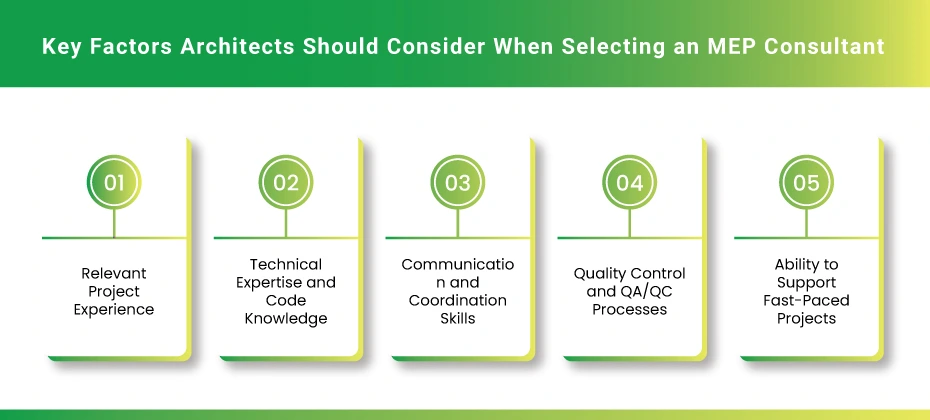
1. Relevant Project Experience
One of the first questions architects should ask is whether the consultant has experience with similar project types.
Different building sectors have unique requirements. For example:
- Healthcare facilities require strict ventilation standards.
- Multifamily residential projects involve complex plumbing layouts.
- Retail spaces often prioritize flexibility and energy efficiency.
- Educational buildings require specialized occupancy and comfort considerations.
A consultant who regularly works on similar projects is more likely to understand common challenges and provide practical solutions.
Ask for:
- Project examples
- Case studies
- References
- Relevant design experience
Past performance can often indicate future success.
2. Technical Expertise and Code Knowledge
Building codes and industry standards continuously evolve. MEP consultants must stay current with applicable regulations and best practices.
Architects should evaluate a consultant’s understanding of:
- Building codes
- Energy codes
- Accessibility requirements
- Sustainability standards
- Local jurisdiction requirements
Strong technical knowledge helps avoid costly revisions and permit review issues later in the project.
A consultant who understands both code compliance and design intent can provide greater value throughout the design process.
3. Communication and Coordination Skills
Technical expertise alone does not guarantee project success.
Many project challenges arise from communication gaps rather than design deficiencies.
Architects should look for consultants who:
- Respond promptly
- Participate actively in coordination meetings
- Communicate clearly
- Provide regular project updates
- Collaborate effectively with design teams
Successful projects often result from strong working relationships between architects and engineering consultants.
An MEP consultant should function as an extension of the project team rather than simply a service provider.
4. Quality Control and QA/QC Processes
Even highly experienced engineers can make mistakes without proper quality control systems.
Architects should ask potential consultants about their Quality Assurance and Quality Control (QA/QC) procedures.
Questions to consider include:
- How are drawings reviewed before submission?
- What internal checking processes are used?
- How are coordination issues identified and resolved?
- How do they minimize errors and omissions?
A strong QA/QC process can reduce:
- RFIs during construction
- Change orders
- Coordination conflicts
- Permit review comments
Quality control is often one of the most overlooked factors during consultant selection.
5. Ability to Support Fast-Paced Projects
Many architectural firms operate under tight schedules and changing client requirements.
An effective MEP consultant should be capable of:
- Adapting to design changes
- Meeting accelerated deadlines
- Managing multiple project phases
- Maintaining communication under pressure
Schedule flexibility becomes especially important for commercial, retail, and tenant improvement projects where deadlines can be aggressive.
Red Flags to Watch Out For
Selecting the wrong consultant can create significant project risks.
Here are some warning signs architects should consider carefully.
Limited Coordination Experience
If a consultant struggles to explain their coordination process, it may indicate a lack of experience working within multidisciplinary project teams.
Lack of BIM Capabilities
Firms that rely solely on traditional drafting methods may face challenges coordinating modern projects efficiently.
Unrealistic Promises
Be cautious of consultants who guarantee extremely fast turnaround times without discussing project complexity or scope requirements.
Poor Communication
Slow responses during the proposal stage often become larger communication problems later in the project.
Incomplete Documentation
Poorly developed construction documents frequently lead to delays, RFIs, and construction conflicts.
Questions Architects Should Ask Before Hiring an MEP Consultant
A structured interview process can help identify the right partner.
Consider asking:
Technical Questions
- What project types do you specialize in?
- What building codes do you typically work with?
- How do you approach energy efficiency requirements?
- What BIM tools do you use?
Coordination Questions
- How do you coordinate with architects during design?
- What is your clash detection process?
- How often do you participate in project meetings?
Quality Assurance Questions
- What QA/QC procedures do you follow?
- How do you review drawings before submission?
- How do you reduce design conflicts?
Project Management Questions
- Who will be assigned to the project?
- What is your communication process?
- How do you manage schedule changes?
The answers can reveal whether the consultant aligns with your firm’s workflow and expectations.
How IMEP Engineering Supports Architects
At IMEP Engineering, we understand that successful projects depend on effective collaboration between architects and engineering consultants.
Our team works closely with architectural firms to deliver coordinated, code-compliant, and constructible MEP designs for a wide range of project types.
Our services include:
- Mechanical Design
- Electrical Design
- Plumbing Design
- BIM/Revit Modeling
- MEP Coordination
- Construction Documentation
- Permit Support
We focus on clear communication, proactive coordination, and quality-driven design processes to help architects reduce project risks and improve project outcomes.
By integrating engineering expertise with collaborative workflows, we support architects throughout every phase of project development.
Conclusion
Choosing the right MEP consultant is one of the most important decisions architects make during project planning and design.
Beyond technical expertise, architects should evaluate a consultant’s communication skills, BIM capabilities, project experience, quality control processes, and ability to collaborate effectively with the design team.
A strong MEP partnership can help reduce design conflicts, improve project coordination, accelerate schedules, and support successful construction outcomes.
By taking the time to evaluate consultants carefully and selecting a partner who aligns with your project goals, architects can create more efficient, coordinated, and high-performing buildings while delivering greater value to their clients.