

Planning a healthcare facility in the U.S.? Missing a single requirement from NFPA 99 or misaligning with ASHRAE 170 can delay your project, increase costs, and create serious compliance risks.
Healthcare construction isn’t just complex, it’s unforgiving. Every MEP (Mechanical, Electrical, and Plumbing) decision directly impacts patient safety, operational reliability, and regulatory approval.
This guide gives you a practical, U.S.-focused healthcare MEP pre-construction checklist to help you avoid costly mistakes before groundbreaking.
What Is a Healthcare MEP Pre-Construction Checklist?
A healthcare MEP pre-construction checklist is a structured verification process used before construction begins to ensure that all mechanical, electrical, and plumbing systems:
- Comply with U.S. healthcare codes and standards
- Support clinical operations safely and efficiently
- Minimize redesign, delays, and costly rework
It acts as a risk-control tool, ensuring your project is buildable, compliant, and future-ready.
10 Critical Healthcare MEP Pre-Construction Checklist (U.S.)
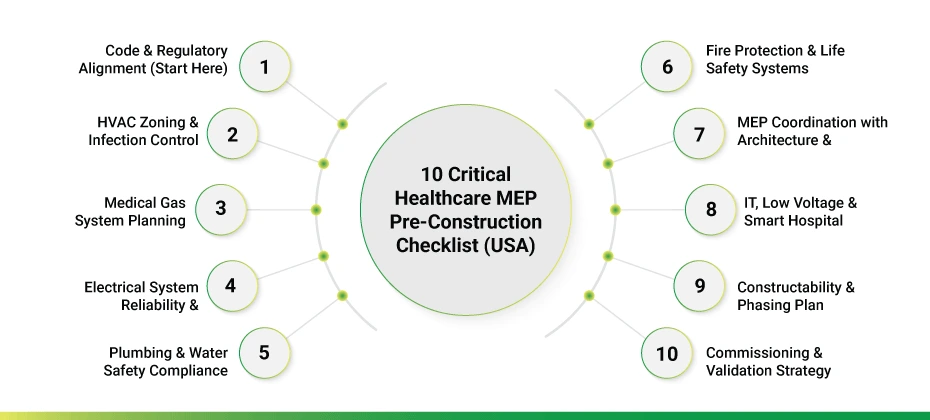
1. Code & Regulatory Alignment (Start Here First)
Before anything else, confirm your design aligns with required U.S. codes and standards:
- NFPA 99 – Medical gas and electrical risk categories
- NFPA 70 – Electrical system safety
- FGI Guidelines – Minimum design requirements
Also coordinate early with your Authority Having Jurisdiction (AHJ), as local codes may override national standards.
Common mistake: Ignoring state/local amendments until late-stage approvals.
2. HVAC Zoning & Infection Control Strategy
In healthcare, HVAC is about infection control not comfort.
Your checklist must include:
- Positive and negative pressure room planning
- Air Changes per Hour (ACH) compliance
- HEPA filtration where required
All designs must align with ASHRAE 170.
Critical zones:
- Operating Rooms (ORs)
- Isolation rooms (AIIR)
- ICUs
3. Medical Gas System Planning
Medical gas systems are mission-critical and must be planned with precision.
Verify:
- System layout and zoning
- Source equipment placement (oxygen, vacuum, compressed air)
- Redundancy and backup supply
All systems must comply with NFPA 99.
4. Electrical System Reliability & Redundancy
Hospitals cannot afford power interruptions.
Ensure your design includes an Essential Electrical System (EES):
- Life Safety Branch
- Critical Branch
- Equipment Branch
Backup systems must follow NFPA 110.
Key checks:
- Generator sizing
- Automatic Transfer Switches (ATS)
- Redundant feeders
5. Plumbing & Water Safety Compliance
Healthcare plumbing systems must prevent contamination and infection.
Checklist items:
- Legionella prevention strategy
- Hot water temperature control
- Backflow prevention
Follow guidance from CDC.
6. Fire Protection & Life Safety Systems
Healthcare buildings use a defend-in-place strategy, not full evacuation.
Verify:
- Sprinkler systems per NFPA 13
- Fire alarms per NFPA 72
- Smoke compartments and fire barriers
7. MEP Coordination with Architecture & Structure
Even a perfect design can fail if it doesn’t fit the building.
Pre-construction checks:
- BIM-based clash detection
- Ceiling space coordination (critical in ORs)
- Equipment accessibility for maintenance
8. IT, Low Voltage & Smart Hospital Systems
Modern hospitals depend heavily on digital infrastructure.
Plan for:
- Nurse call systems
- Building Management Systems (BMS)
- Data redundancy and secure networks
9. Constructability & Phasing Plan
Many healthcare projects involve expansions or renovations.
Key steps:
- Conduct an Infection Control Risk Assessment (ICRA)
- Plan construction phasing carefully
- Define safe material movement routes
10. Commissioning & Validation Strategy
Commissioning ensures all systems work as intended before occupancy.
Include:
- Pre-functional testing
- Functional performance testing
- Documentation and verification
Align with expectations from the Joint Commission.
How IMEP Engineering Supports Healthcare Projects?
Navigating U.S. healthcare codes and MEP complexity requires more than just design; it demands deep coordination, compliance expertise, and real-world execution experience.
IMEP Engineering helps healthcare owners, architects, and contractors by:
- Ensuring Code Compliance from Day One
Aligning designs with NFPA, ASHRAE, and FGI standards - Reducing Costly Rework
Identifying clashes, constructability issues, and coordination gaps before construction begins - Optimizing Critical Systems
Designing HVAC, electrical, and medical gas systems for performance, redundancy, and scalability - Supporting Commissioning & Approvals
Preparing documentation and systems aligned with Joint Commission expectations - Future-Proofing Healthcare Facilities
Creating flexible, scalable MEP systems that adapt to evolving healthcare needs
Conclusion
In U.S. healthcare construction, mistakes in MEP planning don’t just impact budgets they impact lives.
A structured pre-construction checklist helps you:
- Stay compliant with critical standards
- Avoid costly rework and delays
- Ensure patient safety and operational reliability
The success of your project is decided long before construction begins.