

Introduction
In modern construction projects, early collaboration between architects and MEP engineers has become essential for delivering efficient, cost-effective, and high-quality buildings. As building systems become more complex, lack of coordination often leads to design clashes, rework, delays, and increased project costs.
When MEP coordination in construction is not planned early, issues emerge during execution that could have easily been avoided during the design stage. This is why integrated workflows and BIM-based planning are now widely adopted in the industry.
Early collaboration ensures that architectural intent and MEP systems are aligned from the beginning, leading to smoother execution and better building performance. This approach is especially important in international markets such as the USA, where design coordination and compliance standards are highly stringent.
Why Coordination Between Architects and MEP Engineers is Critical
Architecture and MEP engineering must work together to create a functional building.
Architects focus on spatial design, aesthetics, and usability
MEP engineers design essential building systems like HVAC, electrical, plumbing, and fire safety
However, these systems often overlap within ceilings, shafts, and structural zones. Without proper architectural and MEP coordination, conflicts are inevitable.
This is why an integrated building design process is essential for modern construction projects.
Common Problems Caused by Late MEP Coordination
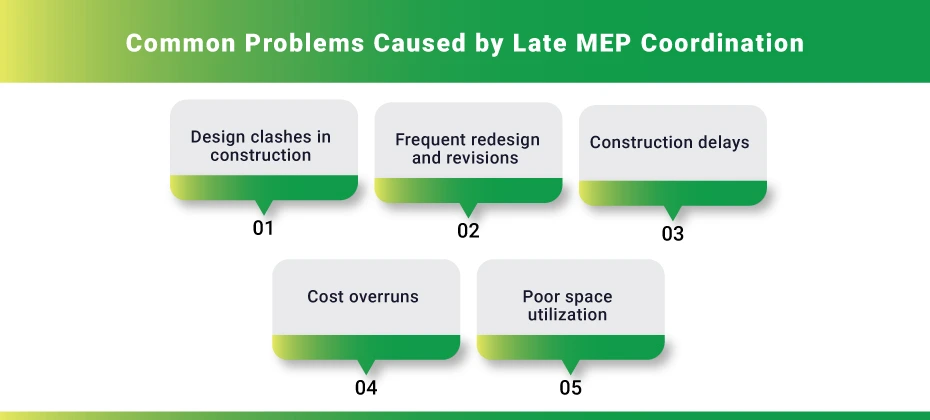
When MEP design is introduced late in the project, several issues occur:
1. Design clashes in construction
Ducts, pipes, and cables often conflict with structural elements due to lack of early planning.
2. Frequent redesign and revisions
Late-stage changes in MEP layouts lead to repeated updates in architectural drawings.
3. Construction delays
Clash resolution during execution slows down project timelines.
4. Cost overruns
Rework and material wastage significantly increase project costs.
5. Poor space utilization
Improper planning reduces usable ceiling height and congests service zones.
These issues highlight the importance of MEP design clash detection during early stages.
Impact of Poor Coordination on Construction Projects
Poor coordination between disciplines leads to:
- Increased construction rework
- Delayed project completion
- Reduced quality of installation
- Inefficient use of building space
- Higher operational and maintenance issues later
These challenges directly affect project profitability and client satisfaction.
What is Early Collaboration in Building Design?
Early collaboration refers to involving MEP engineering services during the concept and schematic design phases instead of after architectural freeze.
In this approach:
- Architects, structural engineers, and MEP consultants work together from day one
- Design development happens in parallel
- Spatial planning considers MEP systems early
- Conflicts are resolved before construction begins
This approach is a key part of the integrated building design process.
Role of BIM in MEP Coordination
BIM coordination in building design plays a major role in improving project efficiency.
Using Building Information Modeling (BIM):
- Architectural and MEP systems are modeled in 3D
- Clash detection is performed before construction
- Design issues are identified early
- Coordination between teams becomes faster and clearer
- Rework on site is significantly reduced
BIM enables a shift from reactive problem-solving to proactive design coordination.
Benefits of Early Collaboration Between Architects and MEP Engineers
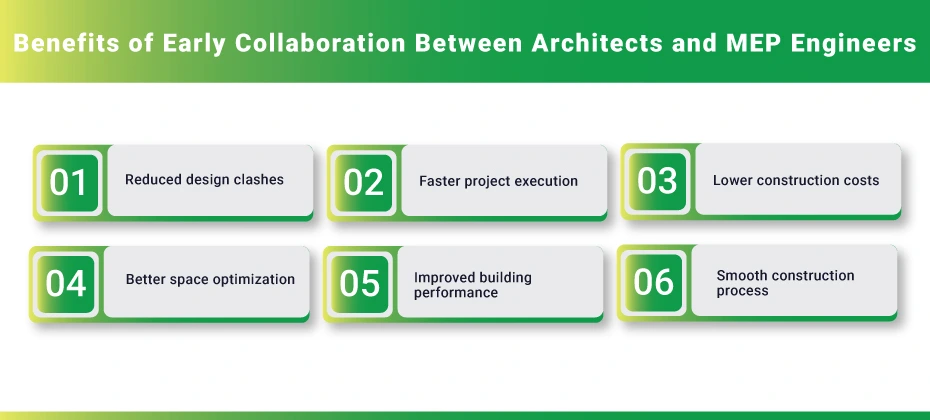
Implementing early-stage coordination provides several advantages:
1. Reduced design clashes
Conflicts are identified and resolved before construction starts.
2. Faster project execution
Less rework leads to smoother workflows and faster delivery.
3. Lower construction costs
Early planning reduces material waste and redesign expenses.
4. Better space optimization
MEP systems are efficiently integrated into architectural layouts.
5. Improved building performance
Well-coordinated systems improve efficiency and sustainability.
6. Smooth construction process
Contractors receive clear, coordinated, clash-free drawings.
Role of MEP Engineering Firms in Integrated Design (IMEP Engineering)
Specialized MEP engineering services play a key role in ensuring successful project delivery.
IMEP Engineering supports integrated building design by:
- Providing early-stage MEP design involvement
- Aligning mechanical, electrical, and plumbing systems with architectural intent
- Delivering BIM-based coordination and MEP design clash detection
- Producing coordinated, construction-ready drawings
- Ensuring smooth transition from design to execution
By integrating engineering expertise early in the process, IMEP Engineering helps reduce design conflicts and improves overall construction efficiency.
In addition to supporting local projects, IMEP Engineering also collaborates on USA-based construction projects, aligning designs with international standards, codes, and BIM workflows required in global markets.
Typical Workflow of Coordinated Building Design
A structured coordination process includes:
1. Concept Design Stage
Initial architectural layouts and feasibility planning of building systems
2. Schematic Design Stage
Preliminary MEP design integrated with architecture
3. Detailed Design Stage
Full BIM modeling of architectural and MEP systems
4. Clash Detection & Coordination
Identification and resolution of conflicts in design
5. Construction Documentation
Final coordinated drawings issued for execution
This workflow ensures a smooth integrated building design process.
Conclusion
Early collaboration between architects and MEP engineers is one of the most effective strategies to improve construction quality, reduce costs, and prevent on-site issues.
By adopting BIM-based coordination and involving MEP engineers early in the design phase, construction projects can move from reactive problem-solving to proactive planning.
Ultimately, successful project delivery depends on architectural and MEP coordination, not just individual design excellence.
Firms like IMEP Engineering play an important role in enabling this integration by delivering BIM-driven, coordinated MEP engineering design services that support efficient and clash-free construction execution.