

Healthcare buildings are among the most complex projects an architect can design. Unlike commercial or residential buildings, hospitals and medical facilities operate as high-performance environments where mechanical, electrical, and plumbing (MEP) systems directly influence patient safety, infection control, and operational efficiency.
In the U.S., healthcare architecture is governed by strict standards such as the Facility Guidelines Institute (FGI Guidelines), ASHRAE ventilation standards, and life safety requirements under NFPA. When MEP systems are not properly integrated into architectural design early, the result is often costly redesigns, coordination conflicts, and compliance issues.
For architects, most MEP failures are not “engineering mistakes” ; they are coordination and spatial planning issues that originate during design development.
Why Healthcare Buildings Require Specialized MEP Coordination
Healthcare facilities are not static environments. They are constantly adapting to patient needs, medical technologies, and regulatory requirements.
Unlike standard buildings, hospitals require:
- Continuous HVAC operation for infection control zones
- Redundant electrical systems for life-support equipment
- Complex medical gas distribution systems
- Strict pressure relationships between spaces
- Highly controlled indoor air quality
Architects must coordinate these systems while maintaining clear spatial hierarchy, patient comfort, and efficient circulation.
A small design oversight in MEP planning can cascade into:
- Reduced ceiling heights in critical care areas
- Non-compliance with healthcare codes
- Delays in inspection approvals
- Long-term operational inefficiencies
Common MEP Design Failures in Healthcare Projects
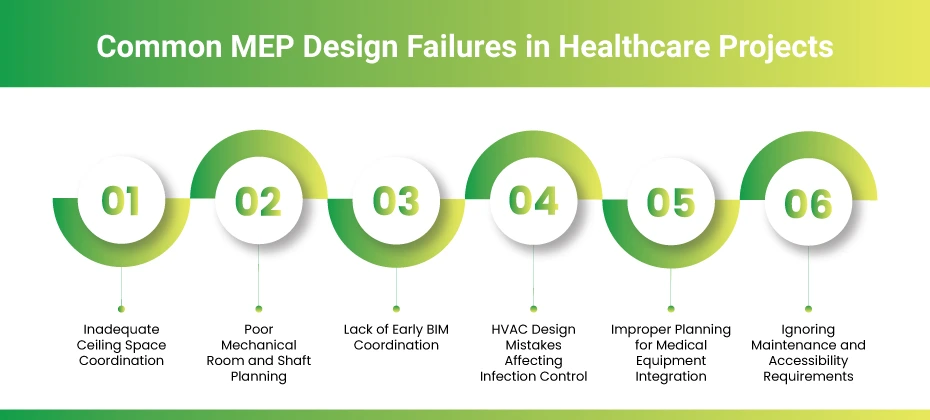
1. Inadequate Ceiling Space Coordination
One of the most frequent issues in healthcare architecture is the lack of coordination in ceiling plenums.
Hospitals require multiple overlapping systems in ceiling space:
- HVAC ductwork
- Lighting systems
- Fire protection piping
- Medical gas lines
- Electrical conduits
- Communication systems
When architects do not reserve adequate plenum depth during schematic design, conflicts occur during construction. This leads to:
- Dropped ceilings lower than intended design
- Re-routing of ductwork and services
- Increased RFIs and change orders
- Loss of architectural intent in key patient areas
Early BIM coordination is essential to prevent these spatial conflicts.
2. Poor Mechanical Room and Shaft Planning
Mechanical rooms and vertical shafts are the backbone of hospital infrastructure, yet they are often treated as secondary spaces during early design phases.
Common issues include:
- Undersized mechanical rooms that cannot accommodate equipment maintenance clearances
- Poorly located shafts that disrupt functional planning
- Lack of redundancy space for future system upgrades
From an architectural perspective, this leads to inefficient floor layouts and limits future adaptability. Once structural grids are fixed, correcting shaft placement becomes extremely difficult and expensive.
3. Lack of Early BIM Coordination
Modern healthcare design relies heavily on BIM workflows, yet coordination often begins too late.
Without early interdisciplinary modeling:
- Mechanical, electrical, and plumbing systems are designed in isolation
- Clash detection occurs only during construction documentation or construction phases
- Architectural ceilings and structural systems are already finalized before conflicts are identified
This results in:
- RFIs during construction
- Rework of coordinated drawings
- Schedule delays and cost escalation
Integrated design platforms and coordination reviews during early design stages are essential.
4. HVAC Design Mistakes Affecting Infection Control
In healthcare environments, HVAC systems directly impact infection control and patient safety.
According to ASHRAE standards and FGI Guidelines requirements, airflow direction, filtration levels, and pressure relationships must be carefully designed.
Common architectural coordination failures include:
- Improper zoning between sterile and non-sterile areas
- Incorrect placement of air supply and return diffusers
- Inadequate isolation for airborne infection rooms
These issues can compromise:
- Regulatory approvals
- Patient safety outcomes
- Operational functionality of critical care units
Architects play a key role in ensuring that room adjacencies and layouts support proper airflow design.
5. Improper Planning for Medical Equipment Integration
Healthcare architecture must anticipate complex medical equipment requirements early in design.
Failures often occur when:
- Imaging equipment requirements are not coordinated with structural grids
- Electrical load and cooling requirements are underestimated
- Equipment access and replacement paths are not planned
This results in:
- Last-minute room redesigns
- Structural modifications after design freeze
- Delays in equipment installation and commissioning
Early coordination with MEP engineers and medical planners is essential to avoid spatial conflicts.
6. Ignoring Maintenance and Accessibility Requirements
Hospitals operate 24/7, which means MEP systems must remain accessible for maintenance without disrupting operations.
Common oversight areas include:
- Valves and dampers located in inaccessible ceiling zones
- Electrical panels blocked by architectural finishes
- Poorly planned service corridors
From an architectural perspective, failure to design for maintainability leads to:
- Increased operational downtime
- Higher lifecycle maintenance costs
- Difficult renovation processes in the future
Good healthcare design always considers “how will this be serviced in 10–20 years?”
Consequences of MEP Design Failures in Healthcare Buildings
When MEP systems are not properly coordinated with architecture, the impact extends far beyond construction issues:
- Project delays: Late-stage redesigns and coordination conflicts
- Cost overruns: Change orders and rework during construction
- Regulatory risks: Failure to meet healthcare compliance standards
- Operational inefficiency: Poor energy performance and system accessibility issues
- Patient safety risks: Compromised air quality, lighting, or critical system reliability
In healthcare architecture, these consequences are not just technical—they directly affect human outcomes.
How Architects Can Prevent MEP Coordination Failures
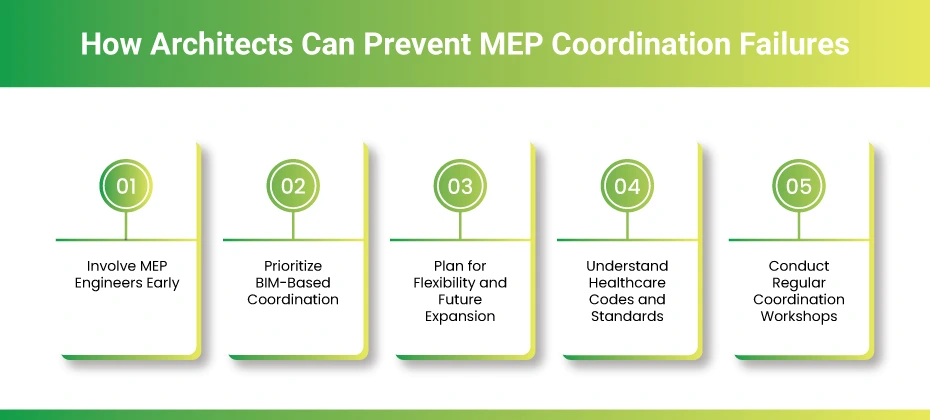
1. Involve MEP Engineers Early
MEP coordination should begin during schematic design, not design development. Early collaboration ensures:
- Proper spatial allocation for systems
- Better integration with architectural intent
- Fewer downstream design conflicts
2. Prioritize BIM-Based Coordination
Building Information Modeling allows architects to:
- Detect clashes early
- Coordinate ceiling and structural systems visually
- Align all disciplines in a shared model environment
This significantly reduces construction-phase surprises.
3. Plan for Flexibility and Future Expansion
Healthcare facilities evolve over time. Architects should:
- Design scalable mechanical and electrical infrastructure
- Reserve expansion zones for future equipment upgrades
- Avoid rigid spatial systems that limit adaptability
4. Understand Healthcare Codes and Standards
Architects do not need to be engineers, but they must understand the design implications of:
- FGI Guidelines
- NFPA life safety codes
- ASHRAE ventilation requirements
These standards directly influence room sizing, adjacency, and spatial planning.
5. Conduct Regular Coordination Workshops
Periodic coordination sessions between architecture, structure, and MEP teams help:
- Resolve spatial conflicts early
- Align design intent across disciplines
- Reduce documentation errors
- Improve constructability
Best Practices for Healthcare MEP Coordination
- Define clear ceiling coordination zones early in design
- Allocate realistic mechanical room sizes with maintenance access
- Use BIM models as decision-making tools, not just documentation tools
- Coordinate medical equipment requirements during schematic design
- Prioritize lifecycle performance over initial spatial efficiency
Conclusion
MEP design failures in healthcare buildings rarely begin as engineering errors they begin as coordination gaps during architectural design. For architects, the challenge is not just designing beautiful or functional spaces, but ensuring those spaces can physically support complex life-safety and clinical systems.
Early collaboration, BIM-based coordination, and a strong understanding of healthcare standards such as the FGI Guidelines, ASHRAE, and NFPA are essential to delivering successful healthcare projects.
Ultimately, better MEP coordination leads to better hospitals and better outcomes for patients and staff alike.